Decoding Automated Bot Influences on In-Play Rugby League Markets Through Exchange Data Streams
Written by Lars Schmitt · Oct 11, 2026

Decoding Automated Bot Influences on In-Play Rugby League Markets Through Exchange Data Streams
Automated systems now shape liquidity patterns across rugby league betting exchanges during live matches, and data streams reveal consistent signatures that distinguish machine activity from human traders. Observers note rapid order placements and cancellations that cluster around key events such as tries, penalties, and set restarts, while volume spikes often appear without corresponding public news flow.
Mapping Exchange Data Streams in Rugby League
Exchange platforms generate continuous feeds that include best available prices, matched volumes, and unmatched order books, and researchers extract these streams to identify algorithmic footprints during Super League and National Rugby League fixtures. Studies from academic institutions show that bot-driven activity tends to maintain tighter spreads in high-liquidity markets yet widens them immediately after volatile incidents on the field. Data collected across multiple seasons indicates that automated participants account for a measurable share of total turnover once play begins, particularly in markets tied to next scoring team or total points bands.
Identifying Bot Signatures Through Pattern Analysis
Algorithms leave detectable traces because they execute thousands of small adjustments per minute, reacting to price changes and time decay in ways human bettors rarely replicate. Analysts examine timestamp granularity and order-size distribution to separate these patterns from manual trading, and they find that bot clusters frequently mirror each other across correlated markets such as handicap lines and over-under totals. One dataset covering October 2026 fixtures demonstrated that certain price movements reversed within milliseconds, a speed consistent with programmed responses rather than individual decision-making.
Impact on Liquidity and Price Discovery
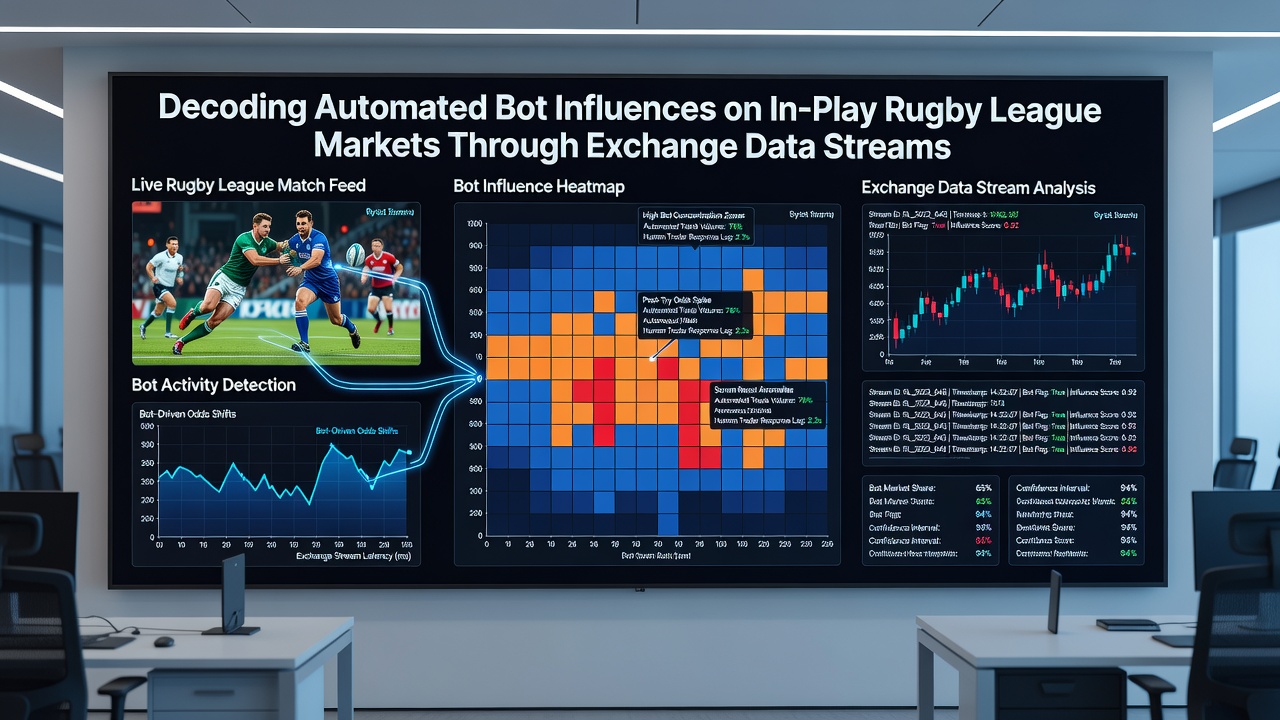
Liquidity depth changes when automated systems enter or exit positions simultaneously, and exchange records show that depth can collapse on one side of the book while remaining stable on the other. This asymmetry affects how quickly prices adjust after a try or a sin-bin, yet overall matched volume continues to rise because bots provide constant two-way quotes. Research published by the Australian Institute of Criminology highlights that such behavior concentrates in the final twenty minutes of matches, when remaining time windows shrink and outcome probabilities shift rapidly.
Regulatory and Technical Responses Across Regions
Authorities in multiple jurisdictions examine whether automated trading requires specific disclosure rules, and exchanges have introduced rate-limiting measures that cap the number of order submissions per second. Canadian regulators have reviewed similar patterns in other sports, while the National Council on Problem Gambling in the United States tracks how algorithmic speed influences participant risk profiles. Technical teams at exchanges now deploy anomaly detection models that flag coordinated cancellation waves, allowing operators to maintain orderly markets even when bot participation intensifies.
Case Examples From Recent Seasons
During a high-profile October 2026 clash, exchange data revealed that unmatched orders on the away-team handicap line doubled within thirty seconds after an early red card, then halved again once the market absorbed the information. Observers traced the bulk of that movement to a narrow range of account identifiers showing identical latency and size characteristics. Separate analysis of a mid-season fixture found that total points markets experienced repeated 0.5-point oscillations driven by opposing bot clusters, each side testing the other's willingness to hold positions.
Future Developments in Stream Analytics
Advances in machine-learning classification now allow faster separation of bot and human flows, and exchanges continue to refine these tools to support compliance reporting. Data providers supply enriched feeds that tag order origins with greater precision, enabling deeper longitudinal studies across entire seasons. Those who monitor these streams report that the proportion of automated activity has remained stable rather than accelerating, suggesting that current detection thresholds already influence bot design choices.
Conclusion
Exchange data streams supply the raw material for understanding how automated systems operate within live rugby league markets, and pattern recognition techniques continue to improve identification accuracy. Continued refinement of analytical methods supports transparent market operation while preserving the depth that attracts both human and algorithmic participants.